
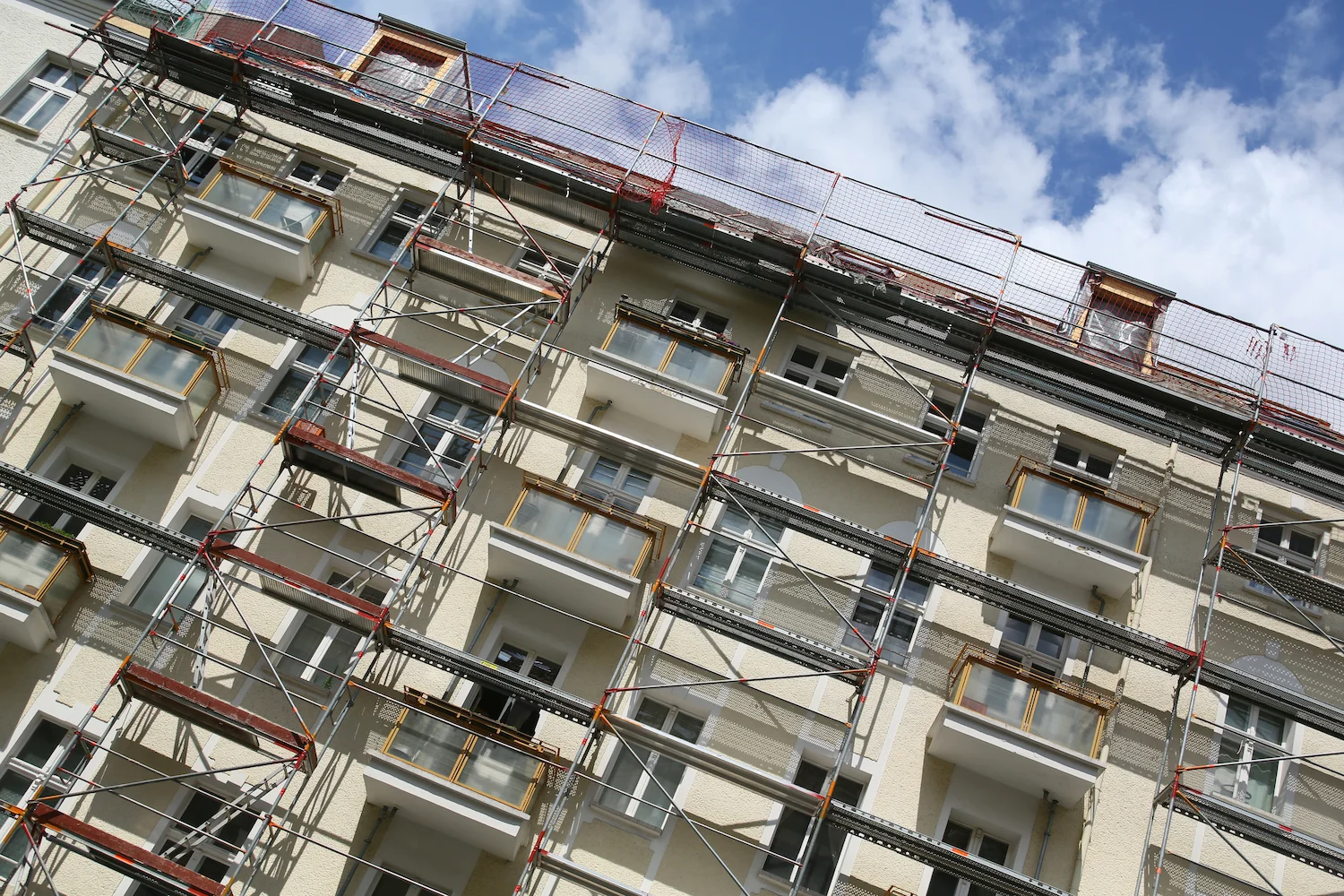
Poor detailing, missing drainage components, and improper sealant installation are among the most common causes of EIFS problems. Learn what New England property managers, facility directors, and commercial building owners should know before EIFS defects become costly building-envelope repairs.
Exterior Insulation and Finish Systems (EIFS) can provide commercial buildings with attractive finishes, continuous insulation, and an effective exterior wall system. However, EIFS performance depends heavily on proper design, detailing, installation, drainage, and maintenance.
For commercial properties throughout Massachusetts and New England, the stakes are particularly high. Freeze-thaw cycles, wind-driven rain, snow, ice, coastal exposure, temperature fluctuations, and aging building envelopes can expose installation deficiencies that may remain hidden for years.
When EIFS is improperly installed, seemingly minor details—such as an incorrectly sealed window opening or missing drainage component—can eventually contribute to moisture intrusion, deterioration of sheathing, corrosion, mold-related concerns, insulation damage, cracking, and expensive façade restoration.
For property managers, facility directors, and commercial owners, understanding the most common EIFS installation mistakes can help prevent premature failure and protect the long-term performance of the building envelope.
What Is EIFS?
Exterior Insulation and Finish Systems, commonly known as EIFS or synthetic stucco, are multi-layer exterior wall systems that typically incorporate insulation, a reinforced base coat, and a textured finish.
Modern EIFS can also incorporate drainage assemblies designed to manage water that reaches behind the exterior finish. Industry guidance distinguishes EIFS with drainage from traditional barrier-type approaches and emphasizes the importance of properly integrating the system with the building’s water-resistive barrier and other exterior-wall components.
EIFS can be a durable building-envelope solution—but it is not simply a finish that can be applied over a wall without careful attention to transitions, penetrations, flashing, drainage, and sealants.
1. Poor EIFS Detailing at Windows and Doors
One of the most consequential EIFS installation mistakes occurs around window and door openings.
These areas contain multiple transitions between materials and are particularly vulnerable to water intrusion. If EIFS details are incomplete or improperly executed around:
- Window heads
- Window jambs
- Window sills
- Door frames
- Flashings
- Parapets
- Roof-to-wall transitions
- Balconies and decks
- Mechanical penetrations
water can find pathways behind the EIFS assembly.
The problem may not immediately appear as an obvious leak. Moisture can migrate into concealed portions of the wall assembly before visible staining, bubbling, cracking, or deterioration appears on the interior.
Why proper detailing matters: The exterior wall must be designed as a complete water-management system—not simply a collection of individual materials.
For Massachusetts commercial construction, the current 10th Edition of the Massachusetts State Building Code, 780 CMR, is based primarily on modified versions of the 2021 International Building Code and includes provisions addressing exterior walls and exterior wall assemblies. Massachusetts identifies 780 CMR Chapter 14 as the chapter addressing exterior walls.
The 2021 IBC also specifically addresses EIFS in Section 1407, including performance, weather resistance, drainage, and installation requirements.
For property owners, the takeaway is straightforward: EIFS detailing should be evaluated as part of the entire building envelope—not as an isolated finish application.
2. Missing or Improperly Installed Drainage Components
A common misconception is that EIFS itself prevents all water from entering the wall assembly.
In reality, exterior wall systems should account for the possibility that water can get behind exterior cladding. Properly designed EIFS with drainage provides a means of directing that water back toward the exterior.
The 2021 IBC Section 1407.4.1 addresses EIFS with drainage and requires a minimum average drainage efficiency of 90% when tested according to ASTM E2273 for applicable assemblies.
Drainage problems can occur when installers:
- Omit required drainage components
- Block drainage paths
- Install incompatible materials
- Fail to properly integrate the EIFS with flashing
- Incorrectly terminate the system
- Fail to maintain drainage openings
- Ignore manufacturer-specific installation details
When drainage pathways are interrupted, moisture can become trapped within the wall assembly.
New England weather makes drainage especially important
Massachusetts, Connecticut, Rhode Island, and New Hampshire experience significant seasonal temperature changes. Commercial façades may be exposed to rain, snow, ice, freeze-thaw cycles, and wind-driven moisture within the same year.
A wall system that does not properly manage water can experience progressive deterioration long before a building owner realizes there is a problem.
3. Improper Sealant Installation
Sealants are one of the most important—and frequently overlooked—components of an EIFS installation.
Sealants help accommodate movement at transitions between EIFS and other materials. They are commonly used around windows, doors, dissimilar materials, expansion or control joints, penetrations, and other locations where movement or differential expansion can occur.
Improper sealant installation can include:
- Inadequate joint preparation
- Incorrect sealant selection
- Poor adhesion
- Insufficient sealant depth
- Improper backer rod installation
- Three-sided adhesion
- Gaps or voids
- Inadequate tooling
- Failed or deteriorated existing sealant
A sealant joint can look acceptable from several feet away while still being improperly installed.
Sealant replacement is not simply “adding more caulk”
When investigating EIFS water intrusion, simply applying another layer of sealant over an existing failed joint may conceal the problem rather than correct it.
A proper repair may require removal of deteriorated sealant, evaluation of the joint and surrounding materials, appropriate preparation, installation of compatible backer material where required, and installation of the specified sealant according to the manufacturer’s requirements and project details.
4. Ignoring the Water-Resistive Barrier
EIFS with drainage relies on more than the visible exterior finish.
The water-resistive barrier (WRB) plays an important role in the overall moisture-management strategy. The 2021 IBC provisions for EIFS with drainage address WRB requirements, including compliance with applicable exterior-wall requirements or ASTM E2570.
Problems can arise when the WRB is:
- Missing
- Damaged during construction
- Improperly lapped
- Poorly integrated around openings
- Incompatible with adjacent materials
- Improperly terminated
- Penetrated without appropriate detailing
A beautiful EIFS finish cannot compensate for a deficient water-management layer behind it.
5. Failing to Properly Integrate Flashing
Flashing is another critical component of a functioning commercial building envelope.
Flashing should be carefully coordinated with EIFS, windows, doors, roof systems, copings, parapets, penetrations, and other façade components.
If flashing is improperly installed or incorrectly integrated with the EIFS system, water may be directed into the wall instead of away from it.
This is particularly important when repairing older commercial buildings where multiple generations of construction materials may exist within the same wall assembly.
6. Installing EIFS Over a Problematic Substrate
EIFS should not be viewed as a way to conceal an underlying wall problem.
Before EIFS installation or major EIFS repair, the substrate should be evaluated for conditions such as:
- Moisture damage
- Deteriorated sheathing
- Cracked masonry
- Corroded metal components
- Structural movement
- Poorly attached materials
- Existing water intrusion
- Unsuitable or contaminated surfaces
Installing new EIFS over a compromised substrate can transfer existing problems into the new wall system.
For an existing commercial property, investigation and substrate preparation are therefore essential parts of a successful EIFS restoration project.
7. Ignoring Movement and Control Joints
Commercial buildings move.
Thermal expansion and contraction, structural movement, differential movement between materials, and building settlement can place stress on EIFS assemblies.
If joints are missing, improperly located, incorrectly sized, or improperly sealed, cracking and water intrusion may develop.
The solution is not necessarily to repair every crack with surface coating. A qualified building-envelope contractor should determine why the cracking occurred before recommending a repair strategy.
8. Using the Wrong Materials or Mixing Manufacturers’ Systems
EIFS is a system—not simply a collection of interchangeable products.
Adhesives, insulation, reinforcing mesh, base coats, finishes, sealants, primers, flashing components, and drainage materials should be compatible with the specified assembly.
Industry guidance such as ANSI/EIMA 99-A provides minimum requirements and design considerations for EIFS and EIFS with drainage, while manufacturers provide project-specific application instructions.
Using products outside their intended application or combining incompatible components can compromise long-term performance.
9. Treating EIFS Cracks as Only a Cosmetic Problem
Cracks are among the most visible EIFS defects—but the visible crack may only be the symptom.
Cracking can be associated with:
- Impact
- Thermal movement
- Substrate movement
- Improper reinforcing mesh installation
- Insufficient base-coat thickness
- Joint deficiencies
- Water intrusion
- Improper detailing
Before patching cracks, commercial property owners should determine what caused the cracking.
A proper EIFS repair strategy should address the underlying condition whenever possible.
10. Skipping Quality-Control Inspections
Even a well-designed EIFS system can fail when installation quality is inconsistent.
Quality-control inspections can help identify issues before the system is concealed by subsequent layers.
Important inspection points may include:
- Substrate condition
- WRB installation
- Flashing
- Drainage components
- Insulation attachment
- Reinforcing mesh
- Base coat
- Expansion and control joints
- Sealants
- Terminations
- Penetrations
- Transitions to other façade materials
For large commercial projects, documentation and coordination among the architect, manufacturer, general contractor, EIFS contractor, and building-envelope professionals can be especially important.
Massachusetts EIFS Code Considerations for Commercial Properties
Massachusetts currently operates under the 10th Edition of 780 CMR, which became fully effective after the state’s concurrency period ended June 30, 2025. The 10th Edition is based primarily on modified 2021 International Codes.
For EIFS projects, several code and industry references may be relevant depending on the building, construction type, occupancy, location, scope of work, and applicable approvals:
- 780 CMR – Massachusetts State Building Code
- 780 CMR Chapter 14 – Exterior Walls
- 2021 International Building Code Section 1407 – Exterior Insulation and Finish Systems
- IBC Section 1402 – Performance Requirements
- ASTM E2568 – Standard Specification for PB Exterior Insulation and Finish Systems
- ASTM E2273 – Drainage Efficiency Testing for EIFS with Drainage
- ASTM E2570 – Water-Resistive Barrier Coatings Used Under EIFS
- Applicable manufacturer installation instructions
- Applicable Massachusetts energy-code requirements
Massachusetts also has municipalities that have adopted the Stretch Code or Specialized Code, so applicable requirements can vary by project location.
Important: Building-code requirements depend on the specific project and jurisdiction. Property owners and project teams should verify applicable requirements with the architect, building official, code consultant, and EIFS manufacturer before construction or restoration work begins.
Why EIFS Problems Are Particularly Concerning in New England
New England’s climate creates demanding conditions for exterior wall assemblies.
Commercial properties in Massachusetts, Rhode Island, Connecticut, and New Hampshire can experience:
- Freeze-thaw cycles
- Heavy rain
- Wind-driven rain
- Snow accumulation
- Ice
- Rapid temperature changes
- High humidity
- Coastal exposure
- UV exposure
- Seasonal expansion and contraction
These conditions can expose weaknesses in EIFS installation and building-envelope detailing.
For property managers and facility directors, early identification of EIFS defects can help prevent a localized façade issue from becoming a larger waterproofing, masonry, concrete, or interior damage problem.
Signs Your Commercial EIFS May Need Professional Evaluation
Property managers and commercial owners should consider an EIFS inspection if they notice:
- Cracking or spider cracking
- Bulging or delamination
- Discoloration
- Staining
- Soft or damaged areas
- Repeated interior water leaks
- Deteriorated sealant
- Failed joints
- Damaged flashing
- Mold or musty odors near exterior walls
- Window or door perimeter leaks
- Visible impact damage
- Previous unsuccessful EIFS repairs
Not every visible defect indicates systemic EIFS failure. However, recurring problems should be investigated before additional cosmetic repairs are performed.
ESI Waterproofing & Masonry Restoration: EIFS Expertise for New England Commercial Properties
For commercial owners and property managers, successful EIFS restoration requires more than repairing the visible surface.
ESI Waterproofing & Masonry Restoration Inc. specializes in building-envelope and exterior restoration services, including:
- EIFS repair and restoration
- Stucco repair
- Waterproofing
- Masonry restoration
- Concrete restoration
- Historical restoration
- PVC siding replacement
- Clapboard siding replacement
- Exterior façade repairs
ESI’s broader expertise in waterproofing, masonry, concrete, and exterior restoration allows EIFS conditions to be considered within the context of the building’s overall exterior envelope.
That matters because EIFS defects can intersect with masonry, concrete, windows, flashing, sealants, waterproofing, roof transitions, and other building components.
Whether a property requires localized EIFS repairs or a larger façade restoration strategy, the goal should be the same: identify the source of the problem, address the underlying condition, and restore the building envelope for long-term performance.
Visit ESI Waterproofing & Masonry Restoration Inc.
If your Massachusetts, Rhode Island, Connecticut, or New Hampshire property has visible EIFS deterioration, recurring leaks, failed sealants, or concerns about the building envelope, a professional evaluation can help determine the appropriate next step.
Contact ESI Waterproofing & Masonry Restoration Inc. to discuss your commercial EIFS repair, waterproofing, masonry restoration, or exterior building-envelope needs.
Request a FREE evaluation or discuss your upcoming commercial restoration project with ESI today